Early January is the time Bart recommended we plant chives, so I put a clump into our special herb pot by the door to the social room earlier this month. It is surviving, but looks a bit pounded by a goodly rain we had last week.
Yesterday, I went to the bird bath with the idea of changing the water to keep it clean. I noticed the surface looked strange and when I gingerly reached out to test it, I discovered a pancake of ice floating on the top. Well, it is winter, but as I walk around the property I keep seeing signs of burgeoning life. The tropical salvia near the bike rack by the big stump keeps on blooming. Some of the plants have red flowers and others white. Mona gathered beautyberry branches loaded with purple berries from the front retention pond and combined them with ferns and white salvia to dress up the tables for the tea following the memorial service for Marylynn Hall. A bud from the rose bush behind the meetinghouse is now visible through the kitchen window while sitting in the social room. Other flowers are scattered here and there: the tickseed (Coreopsis) is budding and has a few flowers along the front of the meetinghouse; the dune sun flower (Helianthus debilis) is still putting out flowers near the driveway; a lone sneezeweed is (Helenium ssp) is popping up in the grass south of our driveway where I had planted several specimens a couple years back. The bedstraw or stickywilly (Galium aparine) has flowers in many places, but you have to look closely since they are quite small. Another cool season plant is the Virginia pepperweed (Lepidium virginicum). The Wikipedia entry on this member of the mustard family says that young leaves can be boiled for ten minutes or added directly to salads and the young seedpods can be used as a substitute for black pepper.
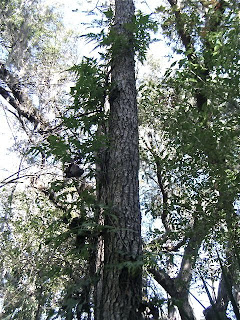
This month, Bill has been working to remove three exotic invasive plants that may not be so familiar to you. One is Japanese climbing fern (Lygodium japonicum), a lacy tree climbing fern.
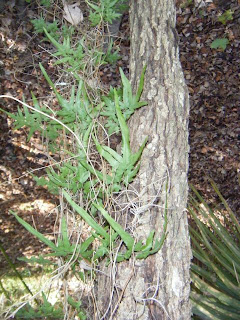
Yesterday I showed Bill a specimen we estimated had climbed ten feet up a tree near the pond, and Bill dug out the roots he could find and helped me bag the whole plant. The spores are carried by the wind, so it can appear anywhere. They remain viable for seven years. I showed the plant to Walter who commented on its attractive appearance. Many of the exotic invasives were brought to Florida because they are attractive as landscape plants when they are kept in check, but reproduce so successfully that they displace the native vegetation that supports a web of insects, birds and animals.  Another invasive is Coral ardisia (Ardisia crenata) whose bright red berries are lovely to see at this time of year. A study at the university came up with a 90% germination rate under good conditions, showing the potential for this invader to spread rapidly. Its fleshy roots help it survive a variety of conditions. A third invasive plant Bill is working on at this
time of year is Taro (Colocasia esculenta), a wild version of a food plant that crowds out wetland plants and makes the wetlands less friendly to the frogs and other creatures that live there.
Recently Bill pointed out an unusual plant with a trio of
Another invasive is Coral ardisia (Ardisia crenata) whose bright red berries are lovely to see at this time of year. A study at the university came up with a 90% germination rate under good conditions, showing the potential for this invader to spread rapidly. Its fleshy roots help it survive a variety of conditions. A third invasive plant Bill is working on at this
time of year is Taro (Colocasia esculenta), a wild version of a food plant that crowds out wetland plants and makes the wetlands less friendly to the frogs and other creatures that live there.
Recently Bill pointed out an unusual plant with a trio of
leaves on one of our walks together around the property. I thought it was so good looking that it surely was an escaped houseplant. When I showed it to Karen Arrington, she said she had seen a native trillium at the John Mahon Park south of Newberry Road between NW 43rd Street and NW 38th Street. A quick check of the Atlas of Florida Vascular Plants revealed that Spotted wakerobin (Trillium maculatum) is the native trillium in our part of Florida. Wunderlin lists all the native trilliums as rare, so I think of this one as a local treasure.


